
Basketball
ArenaPlus Basketball Guide: How Basketball Betting Works
ArenaPlus basketball betting lets adults 21 and over place bets on basketball games, such as the PBA and international FIBA competitions. Every bet comes…
7 min read
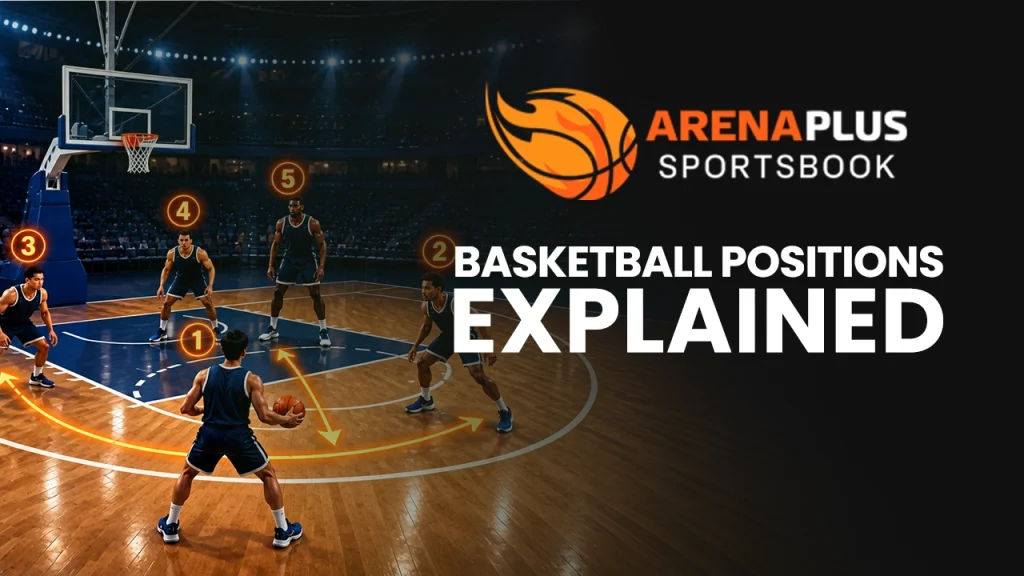
Basketball has five positions: point guard, shooting guard, small forward, power forward and center. Coaches number these basketball positions 1 to 5, from the main ball-handler to the biggest player near the basket.
This guide explains what each position does, how the roles have changed, and how to spot them in a PBA, Gilas Pilipinas or NBA game.
Each team has five players on the court at a time (FIBA Official Basketball Rules). The rules don’t name positions, so basketball positions are roles that coaches assign. Here are the basketball positions and roles at a glance.
| No. | Position | Short name | Main job | Typical build |
| 1 | Point guard | PG | Runs the offense and brings the ball up | Smallest, quickest |
| 2 | Shooting guard | SG | Scores from outside and off the dribble | Quick, strong shooter |
| 3 | Small forward | SF | Scores from anywhere, guards several spots | Long and athletic |
| 4 | Power forward | PF | Rebounds, defends inside, shoots mid-range or deep | Strong, taller |
| 5 | Center | C | Protects the rim, rebounds, scores near the basket | Tallest |
Coaches also group basketball positions more loosely. Guards are the 1 and 2, wings are the 2 and 3, and bigs are the 4 and 5.
[IMAGE: Half-court diagram with the five positions numbered 1 to 5 | Alt: “Basketball positions diagram showing where the point guard, shooting guard, small forward, power forward and center line up” | Rights: original graphic, no clearance needed]
A point guard is the team’s main ball-handler and decision-maker. They bring the ball up the court, call the play and set up teammates for good shots.
Look for the player who carries the ball across half-court and points teammates to their spots. That’s usually the 1. Assists are the stat most tied to this role.
In the NBA, Stephen Curry changed how the position is played by pairing point guard duties with long-range shooting.
The shooting guard is usually the team’s best outside shooter. They score from the perimeter, work off screens and attack defenders who rush out at them.
Shooting guards spend much of the game moving without the ball. Watch for a player curling around a teammate’s screen to catch and shoot. Many 2s also act as a second ball-handler.
The small forward is the most versatile of all basketball positions. A 3 needs to shoot like a guard, rebound like a forward and defend players of different sizes.
Small forwards score in many ways, from three-pointers to drives and post-ups against smaller defenders. Their length often earns them the toughest defensive assignment.
LeBron James, listed as a forward for most of his career, shows how far the role can stretch. He has run offenses like a point guard while guarding bigger players.
The power forward does the physical work near the basket, but the modern 4 also needs to shoot. Traditionally, power forwards boxed out, set screens and scored in the post.
Today many power forwards are stretch fours who shoot three-pointers. That pulls the opposing big man away from the basket and opens driving lanes for guards.
The center is usually the tallest player and the team’s last line of defense. They protect the rim, grab rebounds and score close to the basket.
On offense, centers set screens, roll to the basket and finish lobs and put-backs. Rebounds and blocks are the stats most linked to the position.
In the NBA, Nikola Jokić shows that a center can also be a team’s best passer.
Basketball positions today are more flexible than in past decades. Many coaches now build lineups around skills such as ball-handling, shooting and switching, not fixed spots.
Positionless basketball is a style where players are chosen for their skills, not a fixed position. A lineup might have three wings who can all dribble, shoot and switch on defense.
Some teams play small ball, using a power forward at center for speed and shooting. Others use two traditional bigs to win the rebounding battle.
Commentators use these labels for players who cover more than one role.
| Hybrid label | What it means |
| Combo guard | Plays both point guard and shooting guard |
| Wing | A shooting guard or small forward who defends on the perimeter |
| Stretch four | A power forward who shoots three-pointers |
| Stretch five | A center who shoots from outside |
| Point forward | A forward who handles the ball and runs plays |
Philippine basketball shows every position clearly, with a local twist. In the PBA’s import conferences, teams add an import, or foreign reinforcement, who often plays forward or center.
June Mar Fajardo of the San Miguel Beermen is the league’s model center. He has won a record nine PBA MVP awards, the latest for the 2024–25 season (PBA Most Valuable Player award).
Justin Brownlee of Barangay Ginebra San Miguel plays both small forward and power forward. He became a naturalized Filipino in 2023 and also suits up for Gilas Pilipinas (Justin Brownlee).
For the national team, Kai Sotto gives Gilas rare size at center. His FIBA profile lists him at 2.16 m (FIBA).
You can usually identify basketball positions within a few possessions. Use this routine the next time you watch.
Lineups change through a game, especially when coaches go small or big. Re-check after each substitution.
No single position is the most important of the five basketball positions. A team needs all five roles working together to win.
Shorter players usually play point guard or shooting guard. These roles reward speed, ball-handling and shooting more than height.
A center usually plays closest to the basket and is the main rim protector. A power forward plays a step farther out and is often expected to shoot from mid-range or beyond the arc.
“The 3” is shorthand for the small forward position. A “3 and D” player is a wing who shoots three-pointers and defends well.
Yes, the five positions mean the same thing in the PBA, FIBA competitions and the NBA. Rule differences, such as game length, change how teams use each role but not the roles themselves.
Now that you know the five basketball positions, see how they work in real games on the basketball hub. Follow PBA and international coverage in the ArenaPlus Insider sports hub, and catch schedules and analysis on the NBA page.
| Claim | Status | Source |
| Each team has five players on the court at a time | Verified | FIBA Official Basketball Rules 2026, Art. 1.1 and 4.2.2 |
| The rules don’t name positions | Verified | FIBA Official Basketball Rules 2026 (no position definitions found) |
| June Mar Fajardo plays for San Miguel Beermen | Unconfirmed | Confirm on pba.ph roster on publish day |
| Fajardo has a record nine PBA MVP awards, latest for 2024–25 | Unconfirmed | Wikipedia: PBA MVP award. Check whether the 2025–26 MVP has been awarded (a July 2026 Manila Times headline said he was “on track for 10th”); confirm on pba.ph |
| Justin Brownlee plays SF/PF for Barangay Ginebra San Miguel | Verified (secondary) | Wikipedia: Justin Brownlee; confirm on pba.ph |
| Brownlee became a naturalized Filipino in 2023 and plays for Gilas | Verified (secondary) | Wikipedia: Justin Brownlee |
| Kai Sotto plays center for Gilas | Verified (secondary) | Wikipedia: Kai Sotto |
| Kai Sotto is listed at 2.16 m | Verified | FIBA player profile. Note: Wikipedia lists 2.21 m; FIBA figure used |
| PBA imports often play forward or center | Expert review needed | General knowledge; reviewer to confirm |
| Curry (guard), James (forward) and Jokić (center) positions | Unconfirmed | Confirm on NBA.com player pages |
Keep reading
ArenaPlus basketball betting lets adults 21 and over place bets on basketball games, such as the PBA and international FIBA competitions. Every bet comes…
7 min read
Basketball odds show two things: how much a bet pays and how likely the sportsbook thinks a result is. In decimal odds, multiply your…
7 min read
The right basketball sportsbook is licensed by PAGCOR, verifies that you’re 21 or older, and shows fair, clear odds on the games you follow.…
7 min read